
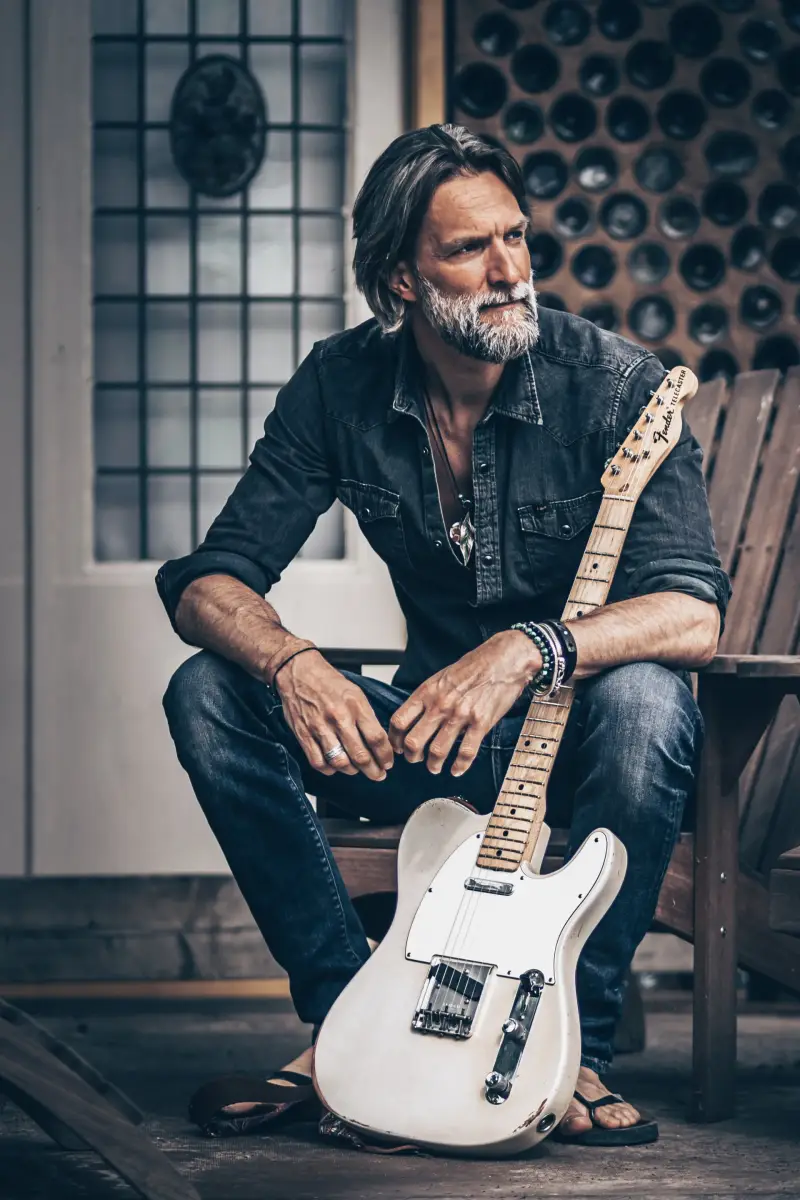
“I still have the eagerness of a kid to keep getting better.”
I’ve known Radboud for a long time. He regularly played with De Helden van 06-11, where I was the lead singer at the time. Our paths kept crossing, and a close friendship also developed between me and his girlfriend—something that has remained over the years. Radboud is a phenomenal guitarist who has increasingly followed his musical heart as time went on. Time for his story on Muzikantenleven!
“My father was a piano tuner, my mother played the organ, and my sister sang a lot. I felt a strong attraction towards music, but I was still searching,” so he says. “As a young boy I took piano lessons, later followed by oboe lessons. Because there was so much music at home, I became aware of music as a product—and of what music can create.”
During that time, Radboud listened mostly to heavier music. “I loved Queen, U2, and the Dire Straits. But something really clicked when I discovered AC/DC and Iron Maiden around the age of sixteen. From that moment on, I knew I wanted to become a professional guitarist.”
A goal
He immediately started taking electric guitar lessons, formed a band with his friend Martijn, and began writing his own songs. “That was mainly instrumental metal. My guitar teacher also introduced me to other styles.” Radboud attended a Waldorf school and didn’t do much academically, but to get into the conservatory he needed a HAVO diploma. “Now I had a goal. It took a while before I actually got that diploma, but at the same time it gave me the opportunity to study extra hard to prepare for the conservatory entrance exams.”
Performing
After being accepted, he studied jazz at the conservatory in Groningen. “That took some to adjust. Before, I was often one of the better guitarists, but at school I became very aware of everything I couldn’t do that well yet. I was surrounded by incredibly talented musicians.” Every week he performed with Martijn under the name A dozen snares at jazz café De Spieghel in Groningen. “That really contributed to my musical development. I started playing more and more with coverbands, and I genuinely enjoyed it. You see people light up because of music—and not unimportantly, the girls liked it too,” he laughs.
Austria and the West
Later, he moved to Austria with bassist Maurice Schotman to live and perform there. They played a lot, but after a year Radboud decided to return. “I consciously chose to live in the western part of the Netherlands because I felt there would be more musical opportunities for me there. I did a lot of gigs with coverbands. And as much as I enjoyed it, I did notice that it slowly started to kill my artistic creativity.”
At that point, Radboud was playing in the party band The Recipe with Karlijn de Vries. “She told me Instagram was fun, so I made an account. At first I posted some random things, but that didn’t get much response. Then I started posting videos of myself playing guitar—more and more things that I personally liked. That quickly started to generate reactions and new followers. I added drum parts to my videos, and suddenly things really took off. I gained a lot of followers. Sometimes I received up to a hundred private messages a day, ranging from people who felt inspired by my playing to actual marriage proposals. But the coolest thing was reading that people felt I had my own sound, my own style. I even got famous followers like Brad Paisley, Pete Townshend, and Tim Pierce. Big brands started sending me products too. Obviously that’s incredibly cool.”
Algorithm
He notices that Instagram is changing. “You have to do more and more extreme things to stand out. And the last thing I want is to become a slave to the algorithm. For me, it’s about doing what feels right.” Still, Instagram has led to beautiful things for Radboud. “I released my own music and now perform my own work with a group of wonderful musicians. Unfortunately, Instagram itself has mostly become a money-making machine.”
Music is healing
Music plays a central role in Radboud’s life. “It’s rare for me to go one day without playing guitar. When I’m on vacation, my guitar comes with me. I’m still as eager as a child to keep improving. When I discover a new artist, I love playing along with their music and exploring what I can learn from it. Playing guitar is meditative for me. I’m always busy with sports, healthy eating, breathing exercises—but playing music truly calms me down,” he says. “There has to be no pressure. If I have a last-minute gig where I need to prepare, it feels completely different. But when I have time and there’s no sense of ‘having to,’ then music is genuinely healing.”
Freedom
It was a conscious decision for Radboud to stop playing regularly in coverbands. “For a while now I’ve been working with Milan Somers, who is known for hypnosis. Together with a few other musicians we played under hypnosis with his guidance, just to see what would emerge. I then ask myself: am I really playing differently because I’m under hypnosis, or am I already in a certain mental state because I’m playing completely from the heart? What I notice is that this is what I’m truly searching for: playing from freedom, with space for your own ‘voice.’ When you do that together, a special dynamic arises.”
He still writes his own music as well. “It might seem like I don’t have a very clearly defined goal, but the freedom of making music—and continuing to grow within that freedom—is absolutely an ambition for the coming years.”
Want to know more about Radboud?
www.radboudwithaar.nl
Maak jouw eigen website met JouwWeb